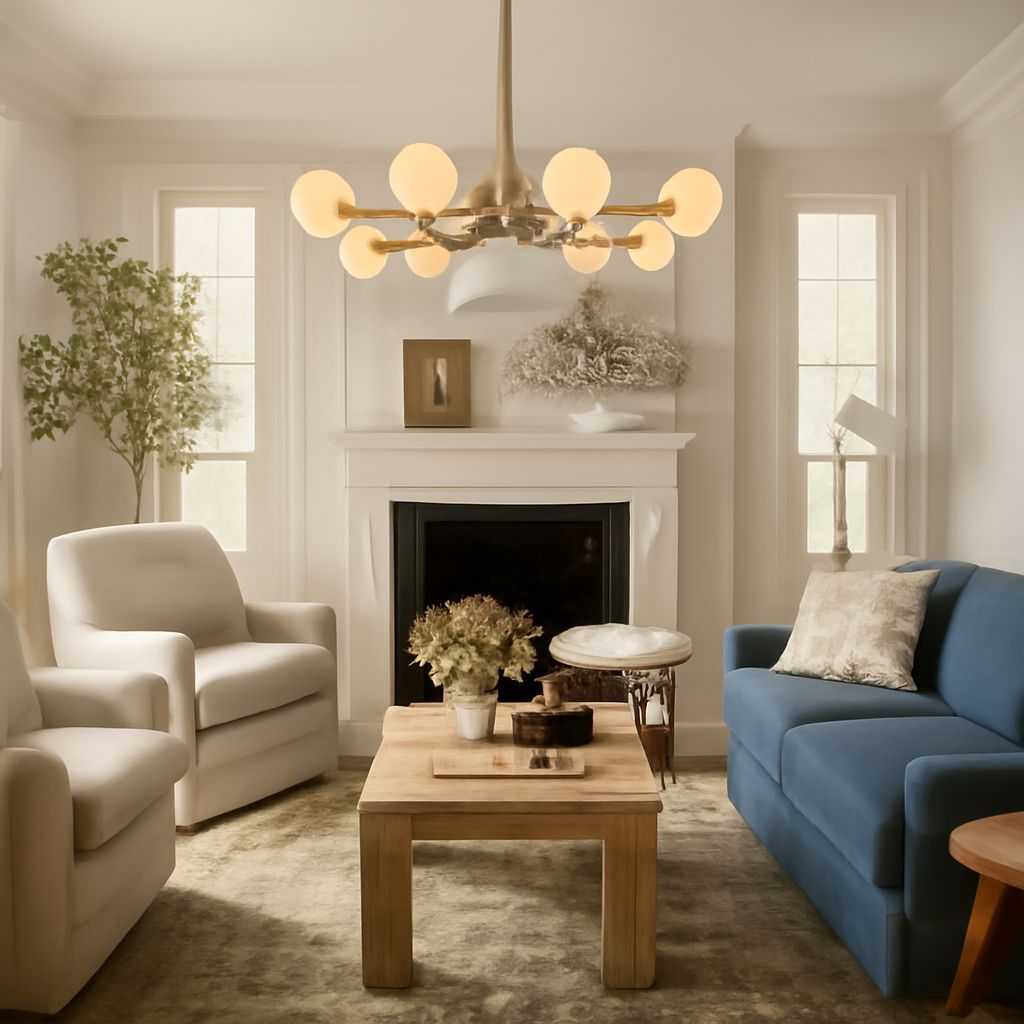
Can one chandelier light an entire living room? It can provide a useful foundation and a visual center, but a comfortable room usually needs other sources for reading, conversation, and evening atmosphere. A chandelier for the living room should be chosen for both its appearance and the way it shares the work with lamps.
Start with the room’s dimensions, ceiling height, furniture layout, and existing daylight. These details reveal whether the main light in the living room should make a quiet contribution or become the feature that organizes the space.
Living Room Light: Start With Layers
A good lighting plan assigns different jobs to different sources. Ambient light provides general illumination so people can move around and see the room. Task light serves a specific activity, such as reading in an armchair. Accent light draws attention to a painting, shelf, or textured wall.
A chandelier in the living area often contributes to the ambient layer, although its effect depends on its shades, bulbs, and direction of light. A floor lamp beside a reading chair supplies a more concentrated beam. A small table lamp can soften a dark corner and make the room feel inviting when the central fixture is dimmed.
These living room light ideas work best when the sources can be controlled independently. Separate controls give the lighting in the living room flexibility throughout the day. For a movie night, a low table lamp may be enough; for cleaning or a gathering, brighter general light may be useful. Consider the actual activities before selecting a fixture on appearance alone.
Match the fixture to the room’s scale
A chandelier that looks dramatic in a showroom can feel heavy in a modest room. Compare its diameter, height, and visual density with the room as well as with the seating area. An open metal frame can appear lighter than a solid drum shade of the same width; a cluster of glass globes may spread across a larger area without forming one opaque mass.
For a 12-by-14-foot living room, imagine a medium-width open fixture above a compact conversation area. A wide, solid fixture might dominate the seating, while a very small one could seem lost against the ceiling. Use the dimensions in a product listing to make a paper outline or mark the width with removable painter’s tape, then view it from the doorway and sofa.
For a larger room with a high ceiling, a wider or taller design may hold its own. Height alone is not a reason to choose the largest option: assess the size of the furniture grouping and the view into adjacent rooms. If the space includes a dining area, the two fixtures should relate in scale without having to match exactly.
Place it where people use and see the room
The center of the ceiling and the center of the seating arrangement are not always the same point. In a rectangular room with a sofa and chairs grouped toward one end, the conversation area may be the stronger visual anchor. In an open plan, a chandelier can also help distinguish the living area from the kitchen or dining space.
A chandelier in living room design must fit the route through the space as well as the view from a seat. Sketch the entry, main walking paths, furniture, and ceiling point. Consider where the fixture will appear from a hallway or through a window, and make sure it does not interrupt a television sightline or feel intrusive above a frequently used path.
A living room light fixture positioned above a coffee table may read as part of the furniture arrangement. The same fixture placed in an open circulation area needs particular attention to headroom. Ceiling height, fixture depth, and the way people move through the room all matter; an electrician can assess the existing ceiling point and the practical options for the selected fixture.
Compare styles by the effect they create
The best choice is not necessarily the one that matches every other finish. Look for a relationship in shape, color, material, or visual weight, and leave room for contrast.
- Open linear frames suit rooms where the view through the fixture matters. Their clean lines can echo a rectangular coffee table or the slim legs of a sofa.
- Shaded designs can create a quieter appearance and soften the view of the light source. Check whether the shade directs enough light into the room for the intended role.
- Glass or sculptural clusters can serve as a focal point in a simple room. Consider how visible bulbs and reflections look from the seats used most often.
- Traditional branched forms can add detail to a formal space or contrast with restrained modern furniture. The finish and proportion determine whether the result feels delicate or imposing.
Living room chandeliers are seen both switched on and off. In daylight, examine the silhouette against the ceiling; at night, consider glare from exposed bulbs and reflections on a television or glossy surfaces. A beautiful frame is less successful if it makes conversation uncomfortable from the main sofa.
Choose light quality as carefully as the shape
Brightness and color influence how a room feels. Lumens describe the amount of light produced; watts describe energy use and are not a direct substitute for comparing brightness across different bulb types. Color temperature, expressed in kelvins, gives a sense of whether white light appears warmer or cooler. Product packaging helps compare these characteristics.
For a relaxed room, many households prefer a warm appearance. Matching or coordinating the color of the chandelier’s light with nearby lamps helps the room feel coherent. If the fixture is dimmable, confirm that the fixture, bulbs, and control are compatible; the ability to lower the light is useful only if the components work together.
A living-room ceiling chandelier with several exposed sources can look brighter than its overall output suggests because individual bulbs are directly visible. Shades or diffusers can reduce that visual intensity. Test the effect from normal seating positions, not just while standing beneath it.
Put the plan together
A small room with a low ceiling may benefit from a compact, visually light chandelier and a separate reading lamp. A taller room with an open seating group can support a more prominent form, supplemented by table lamps near the sofa. In both cases, the fixture’s size matters as much as the shadows and pools of light it creates.
To choose a living room chandelier, mark the seating arrangement and walking paths on a simple plan, note where reading or other tasks happen, and compare two fixtures at their actual dimensions. Select the one that looks balanced from the room’s main viewpoints and leaves each activity with comfortable light.