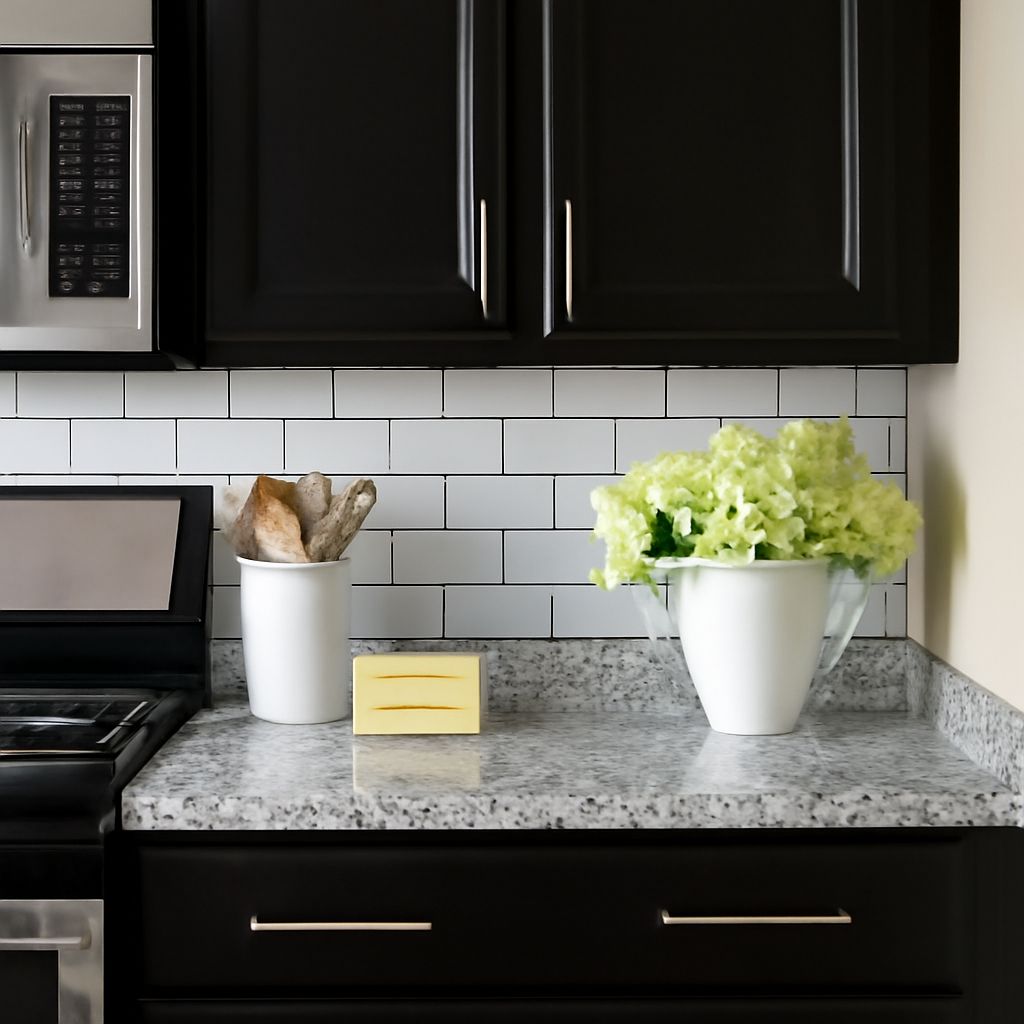
White Subway Tile with Black Grout: Design, Pattern, and Installation Guide
White subway tile with black grout turns a standard tile layout into something with real visual impact. The contrast between the bright white tile face and the dark grout lines makes the pattern the star — every brick course and joint becomes a deliberate design element rather than background material. It’s a high-commitment look, but when executed well, it works across traditional, modern, and industrial interiors.
This guide covers how to use white subway tile black grout in different applications, the design logic behind black and white tile kitchen combinations, how black and white mosaic tile compares to subway layouts, and when black and white peel and stick tile is a legitimate alternative to traditional installation.
Design Principles for White Subway Tile with Black Grout
When It Works Best
White subway tile with black grout reads most effectively in rooms with strong natural light or high-quality task lighting. In dim spaces, the dark grout can make the room feel smaller and heavier. In a well-lit black and white tile kitchen or bathroom, the same combination feels graphic and intentional.
Grout width matters significantly. A 1/8″ grout joint with unsanded black grout produces thin, sharp lines that emphasize the tile grid without dominating it. A 3/16″ joint with sanded grout creates bolder lines — more industrial, more graphic, more demanding of surrounding materials to stay simple.
Pattern Options
The most common subway tile layouts — running bond (half-brick offset), stack bond (perfectly aligned), and herringbone — each read differently with white subway tile black grout. Running bond is the most forgiving and works in virtually any room scale. Stack bond requires precise installation (alignment errors are visible) but creates a clean, modern grid. Herringbone at a 45-degree angle adds movement and energy, but uses roughly 10–15% more tile due to cuts at the edges.
Black and White Mosaic Tile vs. Subway Layouts
Black and white mosaic tile uses smaller individual pieces — often 1″x1″ or 2″x2″ — to create patterns, gradients, or intricate geometric designs. Where white subway tile with black grout creates its effect through grout line contrast, black and white mosaic tile creates it through the arrangement of individual pieces in two colors.
Mosaic installation requires a mesh-backed sheet system. The sheets handle 12–14 individual tiles at once, which speeds installation significantly. Grout selection for black and white mosaic tile is just as important as for subway tile — use unsanded grout for joints under 1/8″ and match the grout color to your dominant tile color (white if majority white tiles, charcoal if majority black).
Black and White Peel and Stick Tile for Temporary Installations
Black and white peel and stick tile has improved significantly in quality and print resolution in recent years. For rental kitchens, temporary bathrooms, or budget renovations, peel-and-stick subway patterns can mimic the look of real tile at $1–$3 per square foot compared to $8–$25 for ceramic and installation.
Black and white peel and stick tile works best over a smooth, clean surface — any texture shows through. Prepare the surface by wiping with isopropyl alcohol and allowing it to dry fully (20–30 minutes) before applying. Start from the center of the wall and work outward for balanced cuts at the edges. Most peel-and-stick products last 3–5 years before adhesion degrades, depending on humidity and heat exposure.