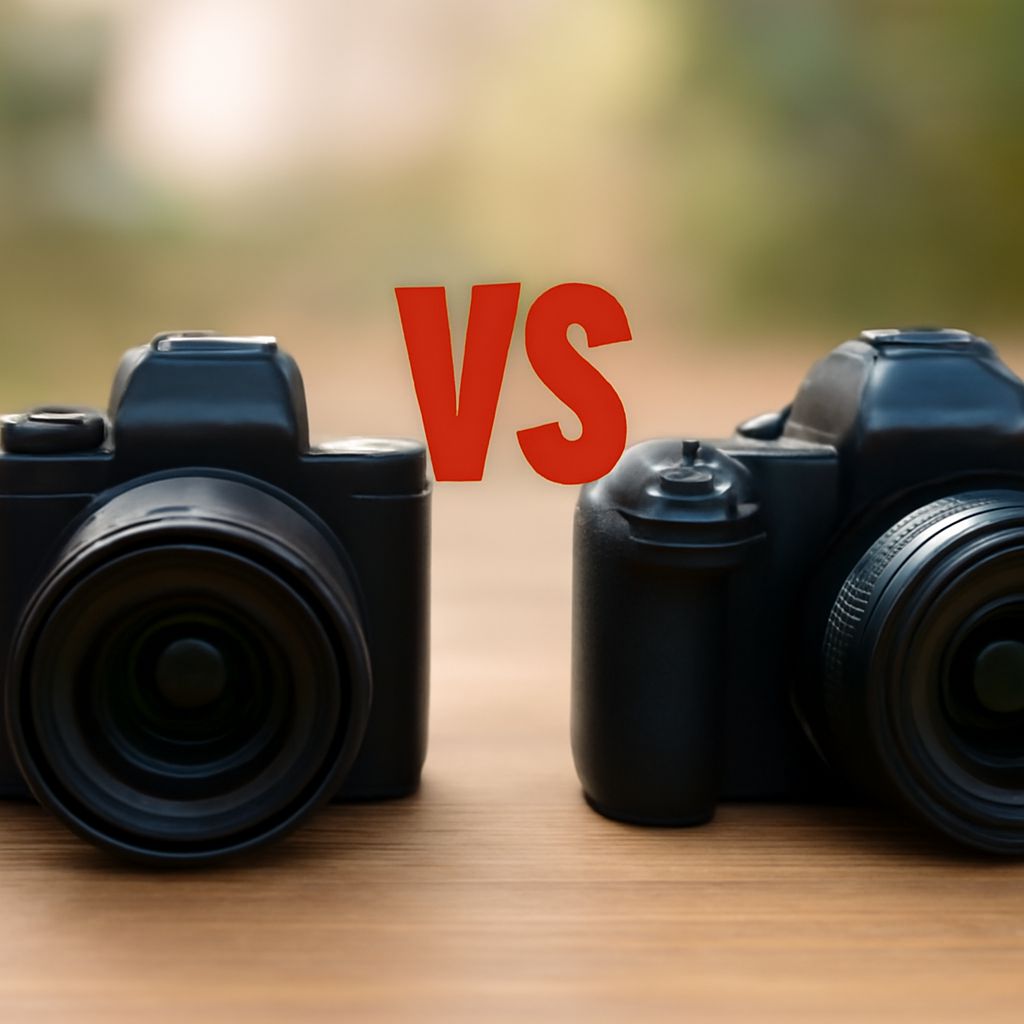
Mirrorless Camera vs DSLR: The Honest Comparison
The mirrorless camera vs dslr debate has largely been settled by the camera market itself: every major manufacturer has shifted new development resources toward mirrorless, and the best DSLR bodies available today were designed 5–10 years ago. But that doesn’t make the dslr vs mirrorless camera choice simple for buyers — used DSLR systems still offer enormous value, and mirrorless isn’t automatically better for every shooting scenario.
This guide covers the practical difference between mirrorless camera and dslr systems in terms of autofocus, battery life, size, lens ecosystem, and overall value. We’ll answer the specific comparison points that matter most: mirrorless vs dslr camera for sports, travel, and video, and what the term mirror vs mirrorless camera refers to mechanically.
What Mirror vs Mirrorless Camera Actually Means
The mirror vs mirrorless camera distinction refers to a physical component. A DSLR has a reflex mirror inside the camera body that reflects light up through a pentaprism to the optical viewfinder. When you press the shutter, the mirror flips up, exposing the sensor. A mirrorless camera has no mirror — the sensor is always exposed, and the viewfinder (electronic) shows a real-time preview rendered from sensor data.
Removing the mirror makes the camera body shorter from front to back (the “flange distance”), which allows lens designers to place optics closer to the sensor and achieve wider maximum apertures and better corner performance in wide-angle lenses. This is one reason mirrorless vs dslr camera optics often look optically superior in equivalent focal lengths.
Mirrorless Camera vs DSLR: Practical Comparison
Autofocus: Current mirrorless camera vs dslr comparisons favor mirrorless decisively. Sony, Nikon, and Canon mirrorless systems use phase-detection autofocus across the full sensor area with subject recognition (eye, face, animal, vehicle) that DSLR systems cannot match. For sports, wildlife, and event photography, this is the most meaningful practical difference.
Battery life: DSLR wins clearly. A Canon 5D Mark IV gets 900+ shots per charge. A comparable mirrorless body gets 300–400 (though many now support USB-C charging on the fly, which reduces the battery concern in practice). Carry two mirrorless batteries and you match DSLR longevity comfortably.
Size and weight: The camera body is smaller on mirrorless (the mirror vs mirrorless difference), but lenses for mirrorless systems are often larger due to wider apertures and more complex optical designs. A mirrorless body with a 24-70mm f/2.8 may weigh the same or more than a DSLR equivalent. For travel, the body size advantage disappears once you add lenses.
Video: Mirrorless wins significantly. The dslr vs mirrorless camera gap in video — stabilization, autofocus tracking, log profiles, 4K options — is substantial. If video is part of your work, mirrorless is the right choice.