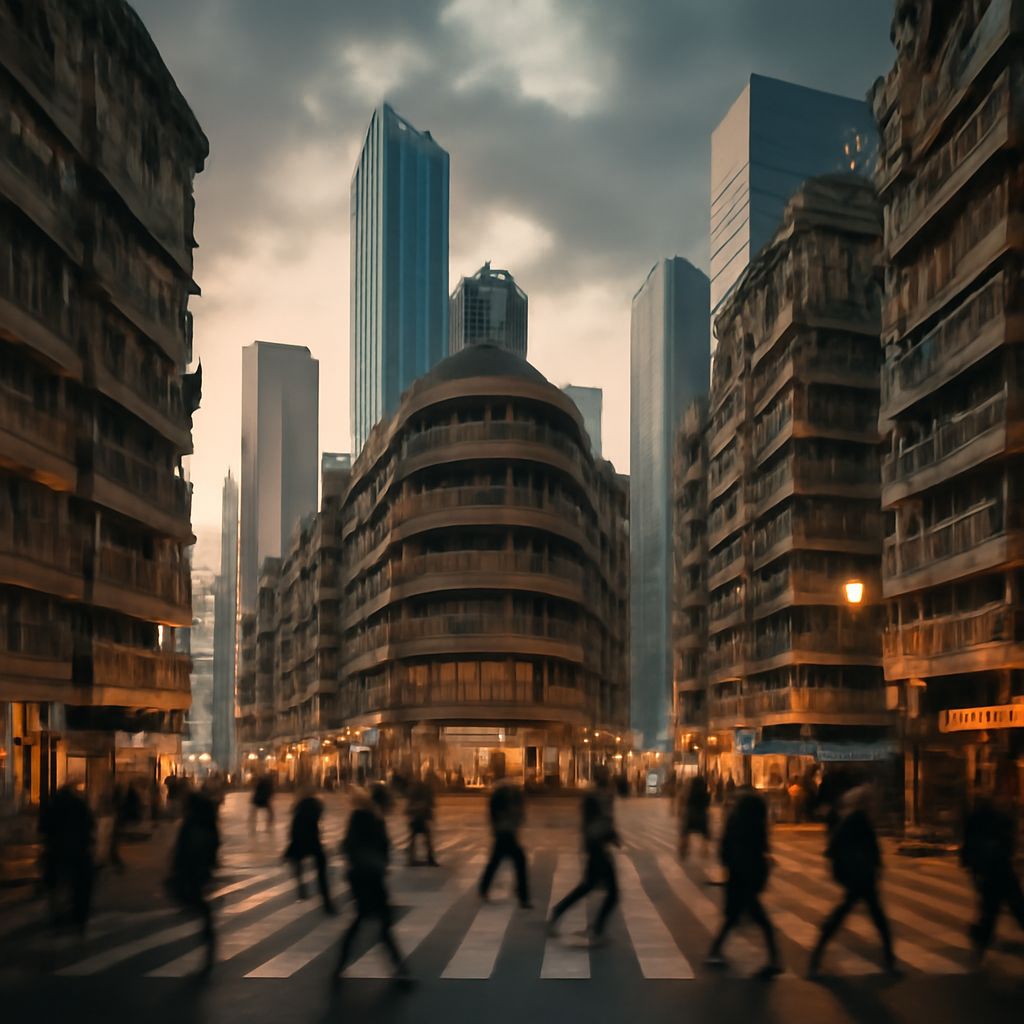
Perspective in Photography: Mastering Night Street and City Shots
Every powerful photograph begins with a deliberate decision about vantage point. Perspective in photography determines whether a street scene feels immersive or distant, whether a building looks imposing or inviting. At night, these choices become even more impactful — the drama of artificial light gives any angle a cinematic quality that flat midday light simply cannot produce. Night street photography rewards patience and movement; you explore a block at different heights and angles until the light and subject align. For urban scenes specifically, city night photography uses artificial light sources — neon signs, streetlamps, car headlights — as creative tools rather than obstacles. Night city photography from a bridge or elevated walkway creates leading lines that guide the viewer’s eye through the frame. And what is night mode on a smartphone? It is a computational tool that stacks multiple exposures to reduce noise and brighten shadows — useful to understand even if you shoot with a DSLR or mirrorless camera.
Using Perspective to Control Urban Scenes
Low angles amplify scale. Crouching at sidewalk level and pointing your camera up at a lit storefront or an arching streetlamp turns an ordinary block into something architectural. Perspective in photography at street level also places the viewer inside the scene — they feel the pavement, the crowd, the momentum of the city rather than observing it from outside.
High angles — from a fire escape landing, a parking structure rooftop, or a second-story window — compress the street below into graphic patterns of light and movement. Long exposures from these elevated positions turn car headlights and taillights into light-painted streaks that only exist because of the vantage point chosen.
Leading Lines in Night City Scenes
Roads, sidewalks, train tracks, canal edges, and building facades all create natural leading lines in city night photography. Position your tripod so the strongest line in the scene enters the frame at a corner and pulls toward a light source or architectural focal point. A wet pavement after rain doubles every line and reflection, effectively giving you two compositions stacked vertically in a single frame.
In night city photography from above, look for radial patterns — circular plazas, roundabouts, or amphitheater seating — that create natural perspective convergence. Center the strongest light in the frame and let the lines radiate outward toward the edges.
Night Street Photography Movement Techniques
Night street photography at 1/60 sec or slower introduces intentional motion blur on moving subjects — a cyclist becomes a luminous streak while a static shopfront stays sharp. This contrast between blurred motion and sharp architecture reinforces the energy of the scene. Use a shutter speed between 1/30 and 1/15 sec to capture both sharp stationary elements and a sense of movement simultaneously.
Night Mode and Long Exposure Settings
Understanding what is night mode on modern smartphones gives context for why computational photography works differently from long exposures. Night mode captures 4–10 frames in quick succession, aligns them to compensate for hand movement, and combines them into a single image with reduced noise and lifted shadow detail. The result is impressive in 3–8 seconds of processing, but it cannot replicate the intentional motion blur or extreme dynamic range of a tripod-mounted DSLR at ISO 400 and f/8.
On a dedicated camera, set ISO between 400 and 1600 depending on available light. A night street photography exposure of 1/125 sec at f/2.8 on a fast prime captures moving subjects sharply. Switch to 4–8 second exposures at f/8 and ISO 100 for tripod work that maximizes detail and dynamic range in static urban scenes. Compare both approaches across 20–30 frames to calibrate your intuition for different lighting conditions.
Key takeaways: Perspective in photography is the first creative decision — choose your angle deliberately before adjusting any setting. Night city photography rewards both high and low vantage points, and leading lines created by roads and architecture guide the viewer through every frame. Understand what night mode does computationally so you can decide when to use it versus when a long tripod exposure achieves what a phone simply cannot.